What a Plumbing Estimate Needs Before the Customer Says Yes
What should a plumbing estimate include? A plain checklist: scope, exclusions, price, permits, payments, warranty and change orders, per California rules.
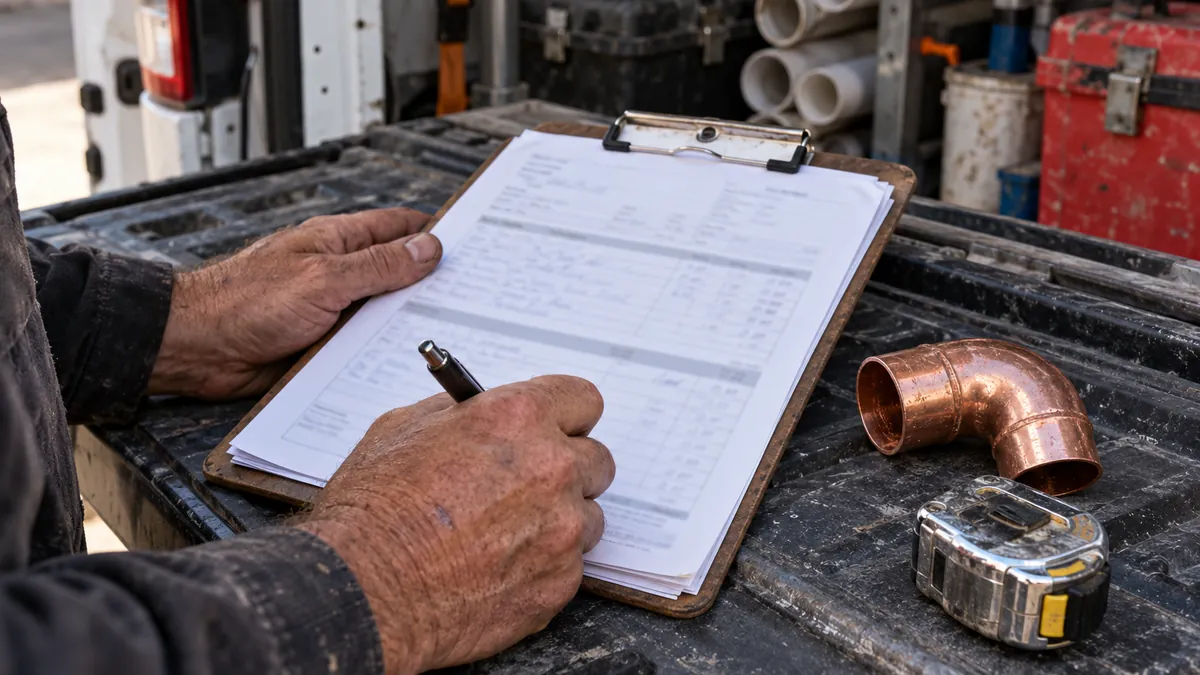
A plumbing estimate should state the work, materials, exclusions, price, payment terms, permit responsibility, dates, warranty, how long the price holds, and how changes get handled. In California, a written contract is required for home improvement projects over $500, and changes must be signed by both sides before the changed work starts.
The estimate should say what is not included
The estimates that cause fights are usually not the ones with a wrong price. They are the ones where the customer assumed the price included patching the wall the plumber had to open. A shop owner reading a stack of old disputes sees the same sentence over and over: “I thought that was included.”
Put exclusions in their own section. Do not hide them in a paragraph at the bottom.
List drywall repair, painting, electrical work, code upgrades found after opening the wall, and permit fees if they are separate. If cleanup and debris removal are included, say so. If they are not, say that instead.
A customer should be able to look at the estimate and see the boundary of your work. That protects the customer and gives you something clear to point to when the question comes up later.
Put your business details at the top
Your estimate should include your company name, business address, phone number, email address, license number, estimate number, and estimate date.
In California, the Contractors State License Board says a contract should include the contractor’s business address and license number. California also requires a written contract for all home improvement projects over $500. Other states differ, so check your own state’s contractor board.
The estimate should identify the customer and the job address. It should not leave anyone guessing which property or fixture the document covers.
Describe the work with sizes and model numbers
“Replace water heater” is not enough detail for a customer comparing two quotes.
Write the scope in plain words. Identify the fixture or water heater by manufacturer and model number when that information is available. Include sizes. State who will remove the old equipment, who will install the new equipment, and what work each party will perform.
The California Contractors State License Board says the contract should describe in detail the products used and how the work will be performed. That includes the size, color, amounts of materials, and manufacturer model number.
Itemize labor and materials clearly enough for the customer to compare your estimate with a second quote. Your pricing method should also be clear. If you bill flat-rate, say that. If you bill hourly, state the rate and how materials are handled. This flat-rate or hourly breakdown can help you set that out plainly.
State the price and when it expires
Show the total price. Show enough detail beneath it that the customer can see labor, materials, permits, and other charges that apply.
Then state how long the estimate remains valid. Use a specific expiration date or a specific period. Materials move, and copper prices keep moving. Your written price should not stay open forever.
If a customer asks for a price before you have enough facts, do not turn a guess into a promise. The first phone call should collect the details that make the estimate possible. This guide on what to say when a customer asks how much it will cost covers that conversation. And if a quote sits too long, you get the quote that almost got forgotten.
Name the permit responsibility
The estimate should say who pulls the necessary permits. It should also say whether permit fees are included in the price or excluded from it.
The California Contractors State License Board says the contract should give written direction on who gets the necessary permits. Put that responsibility in writing before the customer says yes.
Do not make the customer infer it from a general phrase such as “installation included.” A permit is a separate responsibility and belongs in the estimate.
Write the payment schedule and deposit
Include the payment schedule in writing. State the deposit, progress payments, and final payment.
For a California home improvement job, the down payment cannot be more than $1,000 or 10 percent of the contract price, whichever is less. Payments cannot exceed the value of the work performed, except for the down payment.
Your estimate should show when each payment is due and what work supports it. For wording ideas, see deposits and payment terms.
Give start and finish dates
Include the planned start date and completion date. The California Contractors State License Board lists a date of completion as part of the written contract information.
If the work depends on a permit, special-order material, or a customer decision, identify that in the scope or schedule. Do not leave the customer with only “we will call you.”
Put the warranty in writing
State any warranty on labor and materials in the estimate or contract. The California Contractors State License Board says any warranty on labor and materials must be in writing.
Say what the warranty covers. Identify whether it applies to labor, materials, or both. Keep the wording with the estimate so the customer can find it after the work is complete.
Stop for a signed change order
Unknown conditions behind a wall are not a reason to keep working on a new price based only on a conversation.
If the price or scope changes, use a written change order. It should state the new work and new price, then be signed by the customer and contractor before the change starts. In California, that is the rule for changes to the contract.
Write into the estimate that unknowns found behind the wall will be documented and priced before the changed work continues. The customer gets a clear choice. You get a record of what changed.
Start the estimate with the first phone call
A good estimate starts before you open the template. It starts with the first phone call.
Bella answers your phone around the clock. She asks what is wrong, the address, what the fixture or heater is, and whether anyone has already looked at it. She passes that information to you as a written summary. Your estimate starts from real details instead of a half-remembered voicemail.
Plans are Starter at $95 per month, Growth at $295 per month, and Pro at $495 per month. You can hear Bella answer on the Bella demo line at (669) 284-5564.
Then use those call details to fill in the estimate number, date, scope, materials, exclusions, price, expiration date, permit responsibility, payment schedule, dates, warranty, and change order terms. Do that before you send the document, so the customer is not left to fill in the missing parts with assumptions.