The PEX vs Copper Fight California Took All the Way to Court
California approved PEX, a court threw it out, then it came back. Here is each side's best case and how to quote a repipe when the customer asks.
TL;DR: Both PEX and copper are code-approved in California today. Quote both when the customer cares, explain fire and odor concerns against pinhole history and install time, and record the customer’s preference before the estimate.
California put PEX in the code, then pulled it out
In California, the PEX versus copper argument went to court. It still matters when you answer a repipe call, because the customer’s material question often comes before the estimate.
A call pattern we see on the phone line is homeowners asking about pipe material before they will even book the repipe estimate. Often they read something online or a neighbor had a pinhole leak. Some say up front, “I don’t want plastic.” Others say, “I heard copper leaks.” That question shows up on the call, before you ever see the house.
The California Building Standards Commission certified an Environmental Impact Report on PEX in January 2009. It adopted regulations approving PEX water distribution, and PEX entered the California Plumbing Code in August 2009.
A coalition led by the California Pipe Trades Council sued. The group included the Center for Environmental Health, Consumer Federation of California, Planning and Conservation League, California Professional Firefighters, and Sierra Club California. Their argument was that the state had overlooked health risks from chemicals that may leach from PEX.
On December 30, 2009, Alameda County Superior Court overturned the state approval. The court found that the state had failed to consider possible health risks, taste and odor impacts, and the risk of PEX failure in certain applications.
The commission had to repeal PEX from the state code effective July 1, 2010. The state prepared a new EIR, which led to a settlement. PEX was then allowed in all occupancies under the commission’s jurisdiction, effective August 2010 for the 2007 California Plumbing Code and January 1, 2011 for the 2010 California Plumbing Code.
Contractor magazine and JLC covered the fight. The 2027 Uniform Plumbing Code is out, but code approval does not answer every material question on a repipe.
PEX has a long code history and a short install argument
The Plastics Pipe Institute’s September 2025 report, TR-56, says more than 30 billion feet of PEX tubing have shipped across the United States, Canada, and Mexico since its introduction. PEX entered North American plumbing codes with the BOCA National Plumbing Code in 1993. ASTM F876 and F877 were first published in 1984 and later added requirements for chlorine and UV resistance.
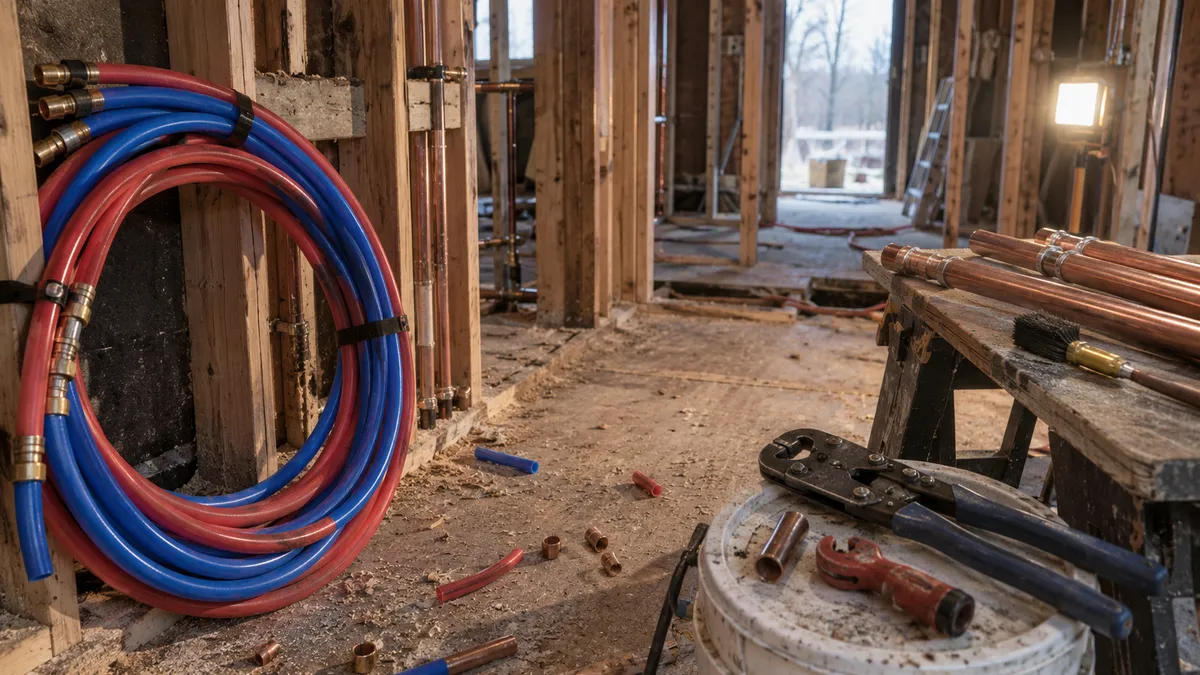
PEX supporters point to ease of installation, reliable connections, and durability. They also point to fewer fittings in a run, no torch on the job, and faster installs. Those are the reasons a plumber may recommend it when the layout and site conditions fit.
PEX for drinking water must be certified to NSF/ANSI 61. Chlorine resistance is tested under ASTM F2023 and rated in classes. The highest class means a rating of 50 years at 140 degrees Fahrenheit under the test conditions.
The argument against copper is not imaginary. Copper is known to suffer pinhole leaks in some water systems. Research from Virginia Tech on water chemistry and flow, along with a study of Santa Fe municipal water published through NIH PubMed Central, ties copper pitting to water chemistry, high flow velocity, and microbial induced corrosion.
That local history matters on a sales call. If homes nearby have a record of pinhole leaks, tell the customer that fact. Do not turn it into a promise about what will happen in one particular house.
Copper’s fire case is real, and so are the plastic water questions
The Copper Development Association says copper melts at 1,984 degrees Fahrenheit. It does not burn or support combustion, and it will not decompose into toxic gases in a fire. Plastic softens around 300 degrees. Copper is also fully recyclable. Plumbing & Mechanical presented the fire safety comparison among copper, steel, and plastic.
Copper advocates also point to research on chemicals and odor. In December 2020, Purdue researchers Andrew Whelton, Amisha Shah, and Kristofer Isaacson heated common plastic pipes, including HDPE, PEX, PVC, and CPVC. They found benzene and other chemicals formed inside the pipe and leached into water after cooling, at temperatures as low as 392 degrees Fahrenheit.
After the 2020 wildfires near Santa Cruz, one water sample showed benzene at 40 times California’s drinking water standard. That sample came from a water system. It was not tied to a specific home’s PEX.
A Purdue release on a 2014 study in Water Research reported that water from a PEX system in a net-zero energy building in Maryland contained 11 chemicals that were PEX ingredients or their breakdown products six months after installation. Some caused odor. That is information a customer can consider. It is not a reason to make a health claim you cannot support.
PEX also has sunlight limits. The manufacturer sets them. Uponor installation guidance says no more than 30 days of direct sunlight. The second digit in a PEX material code, such as PEX 1106, 3206, or 5306, signals 30 days, 90 days, or six months of UV resistance under ASTM F2657.
Store and stage PEX out of sunlight on the job. Read the rating printed on the tube.
The quote should show the trade-off, not pick a winner
Both materials are code-approved in California today. The choice is a quote and a conversation, not a legal question.
Quote it both ways when the customer cares. Explain the trade-off in plain words: fire area and odor concerns on one side, pinhole history and installation time on the other. Point the customer to NSF/ANSI 61 for drinking-water certification. Let the customer choose.
Material cost swings also affect the quote. Copper prices can move, so use the guidance in Copper Prices Keep Moving, Keep Your Quotes Honest. When someone asks for a price before booking, the advice in How to Answer “How Much Will It Cost?” on the Phone applies here too.
A customer who already has another plumber’s number may be looking for a material argument, not just a lower price. The second-opinion call needs a clear answer. A slab leak can also turn into repipe talk, which is why what to ask before you quote a slab leak matters.
Put the customer’s material concern in the call summary
Bella, the Plumber Secretary answering service, does not quote jobs or argue materials. She answers around the clock, books the estimate, and writes the caller’s stated preference, such as “wants copper,” “worried about plastic,” or “neighbor had pinhole leaks,” into the call summary sent by text or email.
That lets you walk in knowing which conversation you are about to have. Plans start at $95 a month for Starter. Growth is $295, and Pro is $495. Call (707) 620-5284. Anyone can hear Bella answer at the demo line, (669) 284-5564.
Change your intake script. Ask which material the customer prefers, why, and whether nearby homes have had pinhole leaks. Quote both options when the answer matters. Keep PEX out of direct sunlight, use the printed UV rating, and do not make health claims in either direction.