The Gas Water Heater Rule Bay Area Plumbers Are Fighting Over
The Bay Area Air District wants to delay its gas water heater rule a year. Both sides still object. Here is each case and how to quote it either way.
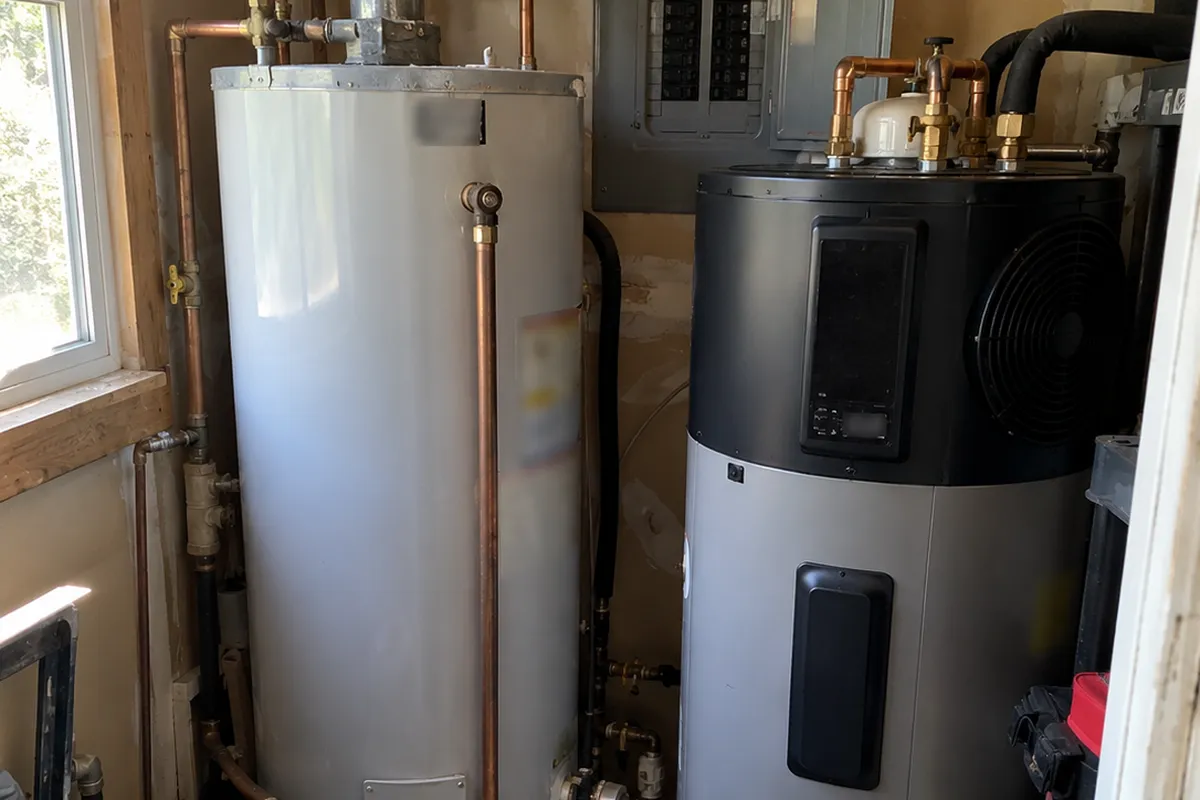
TL;DR: Rule 9-6 would end sales and installations of ordinary gas tank water heaters under 75,000 BTU/hr in Bay Area Air District counties on January 1, 2027. The Air District has proposed moving that date to January 1, 2028, but the board has not voted.
A failed water heater is where this rule gets real
The Bay Area Air District wrote a rule that would end sales and installations of ordinary gas tank water heaters in its counties on January 1, 2027. Now the same agency has proposed delaying that deadline for one year, and both sides still say the draft is wrong.
A broken water heater on a Saturday is the exact moment the rule bites. It lands on your phone, your quote and your schedule.
Water heater calls on a cold morning almost always open with, “we have no hot water,” not “we want a heat pump.” The caller has no idea a rule exists. The panel and closet questions have to be asked by whoever picks up the phone.
Rule 9-6 covers Alameda, Contra Costa, Marin, San Francisco, San Mateo, Santa Clara, southwestern Solano and southern Sonoma counties. It applies to new appliances only. It does not require replacement of an existing working heater.
The current rule sets a zero-NOx standard for residential water heaters under 75,000 BTU/hr. In practice, that means heat pump water heaters. The larger deadlines are January 1, 2031, for water heaters from 75,000 BTU/hr to 2 million BTU/hr, and January 1, 2029, for furnaces.
Where it stands
The Air District published draft amendments on July 14, 2026. The draft moves the first water heater deadline from January 1, 2027, to January 1, 2028.
The draft also includes exemptions for low-income property owners. That category includes Medi-Cal or CalFresh participants, along with households spending more than 28% of income on mortgage and property taxes.
Other draft exemptions address space and electrical limits. A property may qualify if it lacks room or ventilation for a compliant unit. Electrical exceptions cover panels under 100 amps, insufficient electrical capacity, or runs longer than 50 feet.
The reported draft also delays hydronic systems to 2031, multifamily and deed-restricted affordable housing to 2033, and some high-heat businesses. It covers heaters under 30 gallons as another draft item.
Public comment closed August 13, 2026. The Air District board of directors is expected to vote in the fourth quarter of 2026. Until that vote, January 1, 2027, remains the written date.
Outside the Bay Area Air District’s counties, this rule does not apply. It is not a statewide ban.
Supporters say delay keeps dirty equipment in service
The Bay Area Clean Air Coalition, an alliance of environmental groups, urged the Air District not to delay Rule 9-6 past January 1, 2027. Its March 6, 2026 letter was posted by SPUR.
The coalition supports targeted exemptions and financial help for low-income households. Its argument is direct. A delay prolongs pollution and weakens the market shift. Manufacturers, distributors and installers need regulatory certainty.
The Air District says gas water heater emissions contribute to about 85 premature deaths each year in the Bay Area through smog and particulate pollution. That is the agency’s estimate.
Earthjustice has argued that the rules make sure a broken gas appliance gets replaced with non-polluting equipment such as a heat pump. It also says heat pumps cut long-term costs.
A Sierra Club field organizer said the policy “helps our region move forward while giving people the time and flexibility needed.”
Air District executive officer Philip Fine said, “We heard from homeowners that the cost and logistics of switching to cleaner appliances can be real barriers, and we have responded by proposing common sense solutions.”
He also said, “A property owner with an older electrical panel, a tight utility closet or income constraints will have a clear path forward, so a broken water heater will never become a financial crisis.”
Contractors say the emergency process fails the Saturday call
PHCC of California says most replacements do not happen on a schedule. CEO Whitney Squire said, “Most people don’t replace a water heater on a schedule. They replace it because it just failed.” Squire also said, “The exemption process as written assumes there’s time to plan ahead. In the real world, there usually isn’t.”
PHCC wants contractors to complete qualifying emergency replacements immediately, with the owner obtaining the required exemption certificate afterward. It also wants contractors and distributors to keep noncompliant heaters in inventory for qualifying emergency and exempt installations.
The group asks for an electrical exception for obsolete panels such as Zinsco and Federal Pacific Electric. It also wants the Air District to drop the requirement that contractors report the sale price and sales tax for each installed water heater. PHCC cites competitive sensitivity.
The California Apartment Association and San Francisco Apartment Association made a related argument in their joint August 13 letter. They asked for broader exemptions for existing multifamily housing when electrification requires major infrastructure work.
They also asked for a clear emergency process allowing permanent gas replacements when electrical or structural limits make immediate conversion impractical. Some exemptions allow only one noncompliant replacement, they said.
The cost can reach beyond the appliance. The associations cited the Air District’s own analysis, which puts a heat pump water heater installation at about $3,500 more than a gas replacement on average. Actual Bay Area projects ranged from $2,900 to $38,800. Space and electrical limits push costs higher.
How to quote it either way
Plan for both outcomes until the board votes. For a Bay Area job, quote a heat pump unit and a like-for-like option where legal. Put the electrical panel check in the conversation before you give a firm proposal.
Ask these questions on the phone:
- How old is the electrical panel?
- What is the panel size?
- Is there room in the closet?
- Is there a 240V circuit?
- Does the household receive Medi-Cal or CalFresh?
Those answers may affect whether an exemption could apply. They do not let you promise that an exemption applies.
Do not quote a firm price for an unknown panel over the phone. Quote a range and book the site visit. Your process should look like the one described in The Water Heater Call: What to Ask Before You Quote. The advice in How to Answer “How Much Will It Cost?” on the Phone also fits this call.
Check the current Rule 9-6 text at baaqmd.gov before quoting in 2027. The board may change the draft. Review What to Ask on Every Plumbing Call Before You Roll the Truck, and do not let an after-hours caller bypass the screening process. After-Hours Plumbing Calls: How to Stop Losing Them covers that problem.
Bella answers every call 24/7. She can ask the water heater age, panel size, closet space, Medi-Cal or CalFresh questions you set, book the visit and send you the answers. You walk in knowing whether it may be a gas swap or a heat pump job. Plans are Starter at $95 per month, Growth at $295 per month and Pro at $495 per month. Call the demo line at 669-284-5564 or the main line at 707-620-5284.