OSHA's Heat Standard Is Stalled. Builders and Unions Disagree
OSHA’s heat standard is stalled. Here is what plumbing shops can do now with water, early attic work, rest plans, and acclimatization.
OSHA’s federal heat standard has been proposed for two years and still has no finalization date. You can prepare now with water, earlier attic work, planned rest, and a written acclimatization schedule.
OSHA’s heat standard has been waiting since January 2025
OSHA published its proposed rule, “Heat Injury and Illness Prevention in Outdoor and Indoor Work Settings,” in the Federal Register on August 30, 2024. It covers outdoor and indoor work in general industry, construction, maritime and agriculture.
The comment period closed January 14, 2025. OSHA held an informal public hearing from June 16 to July 2, 2025. The post-hearing comment period ended October 30, 2025.
There is still no final rule date. Ogletree Deakins wrote on April 8, 2026 that the proposal “has stalled with no target date for finalization.” The firm said OSHA had taken no further steps toward finalizing it since the comment period closed.
That is the situation right now. The rule has been proposed for two years, it has not been finalized, and employer groups and worker groups are still arguing over it.
A federal heat standard is not in force today. OSHA can still cite heat hazards under the General Duty Clause. OSHA also has a heat National Emphasis Program, revised in April 2026.
The proposal uses 80 and 90 degrees as its triggers
OSHA’s proposal would require employers to create a plan to evaluate and control heat hazards in the workplace.
The initial heat trigger would be a heat index of 80 degrees F. At that point, the employer would provide a rest break when needed to prevent overheating.
The high heat trigger would be a heat index of 90 degrees F. At that point, the proposal calls for a paid rest break of at least 15 minutes every two hours.
The proposal also addresses new workers. Employers could apply the high-trigger measures during a worker’s first week. Or they could use a gradual schedule: 50% of a normal shift on day one, 60% on day two, and 80% on day three.
Those triggers match Oregon’s existing standard. Some states have their own heat rules, so the rule that applies to your shop may depend on where you work.
ABC wants the shop to have more control
The Associated Builders and Contractors supports protecting workers from heat. Its objection is to the proposal as written.
Joe Xavier, ABC’s senior director of health and safety, testified on June 18, 2025. ABC wants supervisors and employees to agree on rest-break approaches that reflect “the individual employee’s needs,” the work, and site conditions.
ABC also wants the rule to focus on heat hazard awareness training. It wants employers to build acclimatization protocols “tailored to their worksite.” It has also asked OSHA to develop a separate regulatory approach for construction.
In its January 14, 2025 comments, ABC urged OSHA to withdraw the proposal and revise it.
Elizabeth Milito of the National Federation of Independent Business took a harder position. At a House subcommittee hearing on September 2, 2026, she urged passage of H.R. 6213. She said the bill would block OSHA from issuing a heat standard now or later. She pointed to the General Duty Clause as the alternative.
The House Education and Workforce Committee approved H.R. 6213 on July 21, 2026. It still needs the full House and the Senate.
The employer-side argument is straightforward. A plumbing shop needs room to account for the job, the site, the employee and the weather. A fixed rule may not fit every attic, crawlspace or mechanical room.
Worker groups say the General Duty Clause leaves a bigger legal gap
Rebecca Reindel, the AFL-CIO safety and health director, told the same September 2, 2026 hearing that the General Duty Clause carries a “broader, higher burden of proof” than a regular OSHA standard.
She cited the 2019 review commission decision in A.H. Sturgill Roofing. That decision reversed an OSHA heat citation because OSHA had not met parts of the required test, including showing the hazard and a feasible way to fix it.
The AFL-CIO’s 2023 report called on OSHA to issue a heat illness and injury prevention standard covering indoor and outdoor workers.
The worker-side argument is also straightforward. A regular standard would tell employers what prevention steps to take before someone gets sick. The General Duty Clause can still apply, but proving the case may be harder.
Both sides say workers should be safe. The fight is over how prescriptive the rule should be.
Marcus’s attic schedule shows where the real problem starts
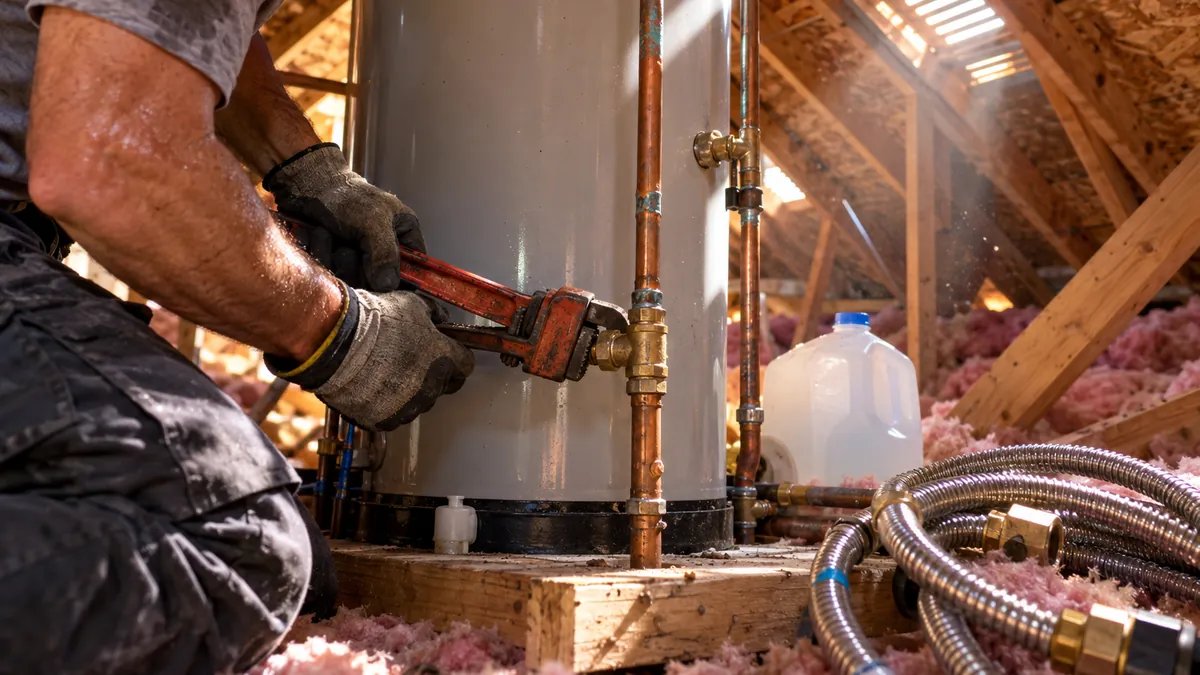
We’ll call him Marcus. He owns a two-truck shop, and his crew swaps water heaters in attics in July. This is a composite, not a real named customer.
On the hottest afternoons, the attic jobs are the ones that run long. His real scheduling problem is not just the heat. Customers insist on the 2 p.m. slot.
That is where you can make a change before OSHA finishes anything. Put heavy attic work in the morning. Keep water on every truck. Set a rest and shade plan. Write down what happens when a worker starts showing signs of overheating.
If you need to price slower attic jobs differently, see flat-rate or hourly pricing on every call. For summer call patterns, see where your plumbing calls come from in summer.
Put the plan on paper before the next hot job
Write a short heat plan for your shop this season.
Keep water on every truck. Schedule heavy attic work in the morning when possible. Decide where workers will rest and get shade. Give new hires a first-week acclimatization schedule using the proposed 50%, 60%, and 80% shift pattern, or use the first-week high-trigger measures.
This is cheap insurance because OSHA can already cite heat under the General Duty Clause. The same principle applies to trench work, where OSHA already has specific requirements. See what OSHA requires when your crew digs a trench.
When you move attic jobs to early morning, tell customers which morning slots are open. Bella answers your phone around the clock, books the appointment, and logs the details while you are on a roof. Plans are Starter at $95 per month, Growth at $295, and Pro at $495. You can hear Bella at the demo line, or call (669) 284-5564.
Do this now: put water on every truck, move heavy attic work to the morning, write the rest plan, and give new hires a first-week schedule. The federal rule can wait. Your crew cannot.