Washington's New Plumbing Code Lets Officials Stop Your Permit
Washington's proposed 2024 Uniform Plumbing Code adds Section 104.4.5, which lets officials suspend a permit while L&I checks licensing. Here is what changes.
TL;DR: Washington’s proposed 2024 plumbing code would let the authority having jurisdiction suspend or revoke a permit, or stop the permitting process, while Labor and Industries checks plumbing licensing compliance. The SBCC has announced May 3, 2027 as the effective date for the 2024 codes, but check the SBCC site for the final adopted rule before relying on that date.
A permit you already pulled could be stopped
A Washington city, town, or county could stop the permitting process while Labor and Industries checks whether the plumbing contractor meets the licensing requirements in RCW 18.106.440.
That is the new proposed Section 104.4.5, titled “Suspension or Revocation.” It would also allow the authority having jurisdiction to suspend or revoke a permit in writing when the permit was issued in error, based on incorrect information, or in violation of an ordinance or regulation.
The Washington State Building Code Council filed the proposal on May 5, 2026, under WSR 26-10-076. It would adopt the 2024 edition of the Uniform Plumbing Code, published by IAPMO, with Washington amendments in Chapter 51-56 WAC.
That proposal replaces the 2021 edition, which Washington made effective March 15, 2024. It is still a proposal. The CR-102 listed August 28, 2026 as the intended adoption date and stated that this was not the effective date. The SBCC adoption cycle page did not yet show a final CR-103 date when checked. The SBCC has announced May 3, 2027 as the effective date for the 2024 codes.
Check the SBCC site for the final adopted rule before you rely on any of those dates.
The licensing check reaches the permit desk
RCW 18.106.440 says a city, town, or county cannot issue a plumbing permit for work by a contractor required to be licensed under that chapter without verifying the contractor’s current license.
The jurisdiction must also show the contractor’s license number on the permit. Applicants must receive written notice about Washington plumbing licensing law and the risks of hiring an unlicensed contractor.
If someone gets a permit by falsifying information to claim an exemption under RCW 18.106.150, the permit is forfeited.
Only L&I-certified plumbers can legally do plumbing work on someone else’s property in Washington. The SBCC says the new section would increase clarity and improve application of RCW 18.106.
For your shop, the practical issue is simple. The license information on the application needs to match the information L&I can verify.
A permit delay becomes a phone problem
We’ll call her Dana. She runs a small Washington shop and pulled a permit for a repipe. The job sat while the city waited on her licensing paperwork. The customer called the office three times that week asking whether the plumber was coming.
That is what a permit problem looks like from the shop side. The customer calls you, not the building department. When the permit stalls, the phone suffers too.
The proposed rule does not change that customer expectation. It gives the authority having jurisdiction a clearer path to stop a permit process while L&I investigates the requirements of RCW 18.106.440.
Keep your L&I contractor license and certified plumber details current. Use the same information on every permit application. Double check what you submit, especially where a permit could be affected by incorrect information.
The proposal also changes daily installation details
The permit rule is not the only proposed Washington amendment. The CR-102 includes these changes:
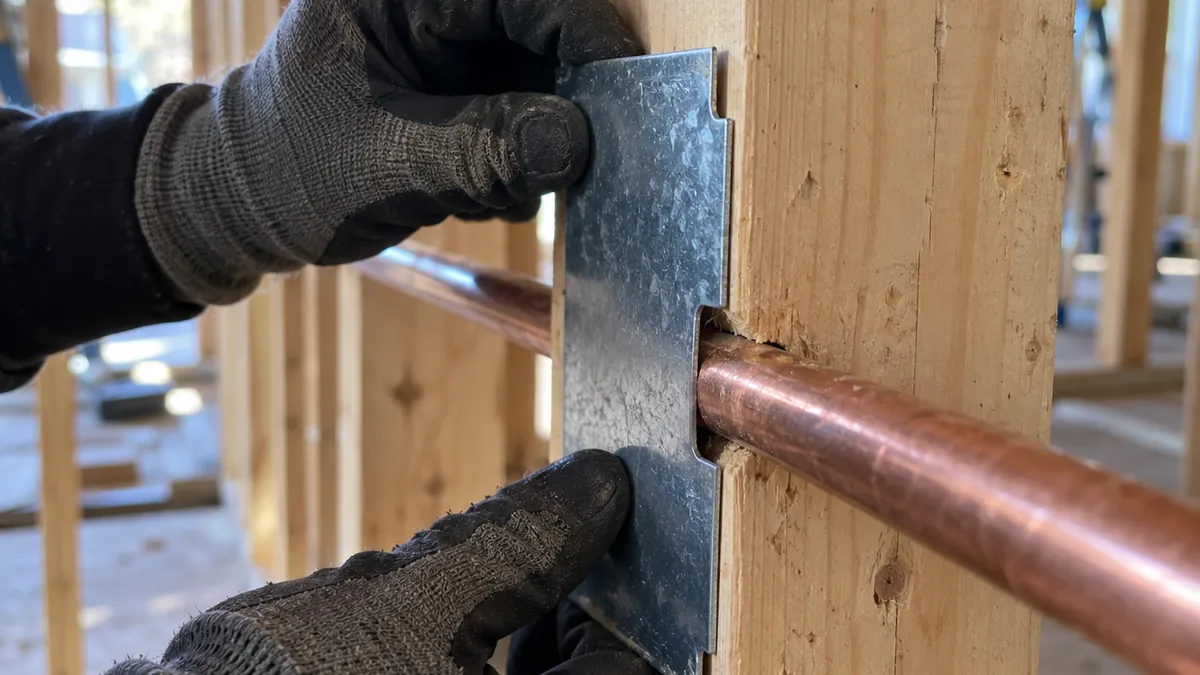
- Section 312.9, new: Steel nail plates must protect plastic, copper, or copper alloy pipe passing through framing within 1 inch of the exposed framing face. The plates must be at least No. 18 gauge, 0.0478 inch or 1.2 mm thick, and extend at least 1-1/2 inches beyond the pipe.
- Section 501.1, modified: Water heaters that use a refrigeration system, including heat pump water heaters, must be installed under ASHRAE 15.2 or Chapter 11 of the International Mechanical Code. Carbon dioxide refrigerant systems must follow Chapter 11 of the International Mechanical Code.
- Section 603.5.22, new: Installation of ASSE 1055 devices is prohibited.
- Section 609.8.3, new: The code addresses performance and safety concerns for hot water recirculating pumps.
- Section 609.13, new: The section clarifies installation standards for water meters required by the Washington State Energy Code.
- Section 603.2 and Table 603.2, modified: Backflow device inspection requirements align with WAC 246-290-010, with updated backflow prevention standards.
- Section 603.5.12, modified: Hydronic piping requirements align with WAC 246-290-490.
- Table 702.2, new: The table addresses intermittent flow discharge.
- Sections 801.8, 814.5, and 814.5.1, new: These sections clarify where hoistway drainage and condensate may discharge.
- Section 1104.1, new: Calculation values for continuous flow are updated.
- Sections 312.9 and 313.1: These sections clarify that seismic restraints follow the building code.
The nail plate, heat pump water heater, and backflow changes are the ones most likely to touch your daily jobs.
Anything not listed or modified in the CR-102 amendments carries over from the 2021 Washington amendments.
The SBCC filing says the proposal likely imposes more-than-minor costs on businesses. It also says those costs do not impact small businesses disproportionately. A preliminary cost-benefit analysis is posted on the SBCC site.
Washington’s 2024 code is not the 2027 edition
Washington is proposing to adopt the 2024 Uniform Plumbing Code. That is separate from the later 2027 edition discussed in the 2027 Uniform Plumbing Code.
Public hearings for Washington’s proposal were held June 10, 2026, in Olympia and June 12, 2026, in Spokane Valley. Written comments closed June 12, 2026.
If you want the background on how code changes move through the process, read how code change proposals work. For a related state change, see New Jersey’s switch to the 2024 code.
What should your shop do before the rule takes effect?
Check the SBCC site for the final adopted rule and the effective date. Do not rely only on the intended August 28, 2026 adoption date or the announced May 3, 2027 effective date.
Review the L&I contractor license information and certified plumber details your office uses on permit applications. Make sure the information matches across your paperwork. Have someone double check applications before submission, since incorrect information can become a reason to suspend or revoke a permit under proposed Section 104.4.5.
When a customer calls about a delayed permit, tell them what you know and what remains with the city or L&I. Keep the heat pump water heater, nail plate, and backflow amendments in front of the people quoting and installing those jobs.
Two questions Washington plumbers will ask
Can the new rule stop a permit after it was issued?
Yes, the proposed Section 104.4.5 would allow the authority having jurisdiction to suspend or revoke a permit in writing when it was issued in error, based on incorrect information, or in violation of a jurisdictional ordinance or regulation. It would also allow the permitting process to stop while L&I investigates plumbing licensing requirements.
When does Washington start using the 2024 code?
The SBCC has announced May 3, 2027 as the effective date for the 2024 codes. The final adopted rule was not yet shown on the SBCC cycle page when checked. Check the SBCC site before relying on that date.
Where Bella fits
Bella answers your shop’s phone around the clock, takes the caller’s name, address, and problem, books the job, and texts you a summary. Plans are Starter at $95, Growth at $295, and Pro at $495 per month. Call (669) 284-5564 to hear Bella answer, or see the Bella demo.
Before you submit the next Washington permit, verify the license details, check the SBCC site, and double check the information on the application.