Apprentice Ratio Fight: One Journeyman, Two Apprentices?
Wisconsin passed a bill letting one journeyworker supervise two construction apprentices, then the governor vetoed it. Both sides, and what it means for your hiring.
Wisconsin passed a bill allowing one journeyworker to supervise two construction apprentices, but Governor Tony Evers vetoed it. The veto stands, so Wisconsin still has a one-to-one rule under current state law.
Wisconsin Assembly Bill 241 passed both chambers in 2026. The Assembly voted 54 to 40 on February 19. The Senate concurred 18 to 15 on March 17. Governor Evers vetoed the bill on April 8. On May 13, the Assembly failed to override him.
It is not law.
Wisconsin tried to move construction apprentices to a two-to-one ratio
Wisconsin law currently uses a one-to-one ratio. Under Wis. Stat. 106.015, the Department of Workforce Development may not require more than one journeyworker for each apprentice. That ratio came from a 2018 law.
AB 241 would have kept the one-to-one ratio for non-construction trades. For construction trades, it would have allowed one journeyworker to supervise two apprentices. The state would decide which trades count as construction trades.
The bill had a simple appeal for shops short on licensed workers. If you cannot hire another apprentice because you do not have another journeyworker, the ratio shuts down the training pipeline. A shop with one journeyworker and enough demand for help may have to turn away a training slot.
That is the workforce argument behind the bill. Associated Builders and Contractors of Wisconsin supported it. The industry expects to need “hundreds of thousands” of new workers, while much of the current workforce is nearing retirement.
The person doing the teaching has to be able to watch the work
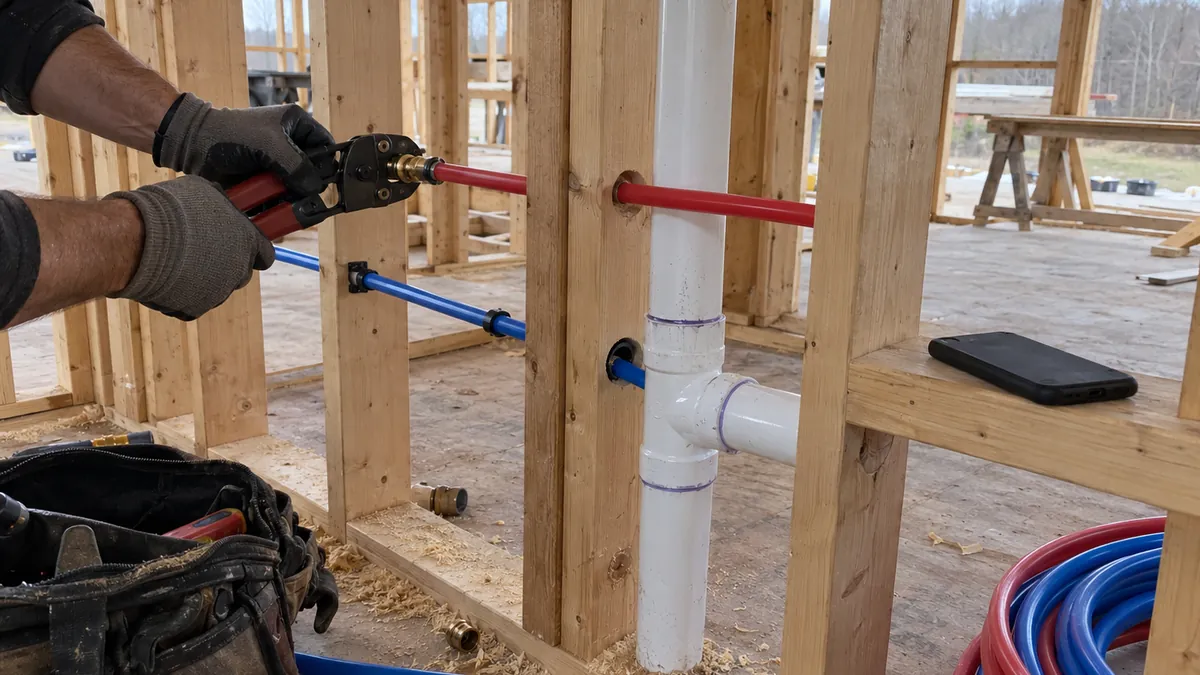
An apprentice does not learn plumbing by standing near a jobsite. The apprentice learns by being watched, corrected and taught while the work is happening.
That is the strongest argument for keeping the one-to-one ratio. One journeyworker cannot watch two people working in two places at the same time. Plumbing also includes gas, hot water and confined spaces. A mistake can become a safety problem before the journeyworker gets there.
Wisconsin DWD Secretary Amy Pechacek put the concern plainly in testimony: “While we understand workforce shortage concerns, AB 241 could have unintended consequences on Wisconsin’s record-breaking apprenticeship program.”
DWD raised concerns about safety, quality of instruction and compliance with U.S. Department of Labor guidance. Plumbers Local 75, the International Brotherhood of Electrical Workers and Operating Engineers Local 139 registered against the bill.
DWD also said AB 241 would not affect collective bargaining agreements that set their own ratios. A state law change would not automatically change every ratio used by a union agreement.
The governor cited oversight, instruction and jobsite safety
Governor Evers’s veto message said that allowing one journeyworker to supervise more than one construction apprentice raised “significant concerns about adequate apprentice oversight, the quality of on-the-job instruction, and jobsite safety in an industry where risks are inherently high.”
The message also acknowledged “the importance of expanding workforce opportunities and addressing labor shortages in the skilled trades.”
The disagreement was partly about process. The governor said changes to apprenticeship standards should be developed with industry partners, labor organizations, training providers and the department. He also said AB 241 was not meaningfully developed through that process.
That leaves Wisconsin with the old rule. The bill passed both chambers, but passage did not make it law.
Connecticut proposed an exception without changing its base ratio
Connecticut took a different approach in 2025. Senate Bill 1465, as amended, passed the Connecticut Senate 35 to 0 in May 2025. The base ratio did not change.
Under the Connecticut rules described in the reporting, electrical, plumbing, heating, piping and cooling, sprinkler fitter, and sheet metal contractors can hire up to three apprentices at a one-to-one ratio. Beyond that, the ratio becomes one apprentice for every three journeypersons. The example given was a company with 12 licensed journeymen that could have only six apprentices.
The amended proposal would have allowed the Department of Consumer Protection to approve a licensed contractor with no disciplinary or enforcement actions in the prior three years to hire up to eight apprentices total without enough journeypersons to meet the ratio.
The contractor would have to show “good cause.” DCP would review the application within 10 days.
Senator Paul Cicarella called it “a middle ground.” He said union and nonunion shops “both had very legitimate concerns.” That was the proposal as it passed the Senate. We could not confirm the final enacted text, so check with your state before you rely on it.
Federal rules set a floor, but your state sets the number
Federal registered apprenticeship standards require a numeric ratio of apprentices to journeyworkers consistent with proper supervision, training, safety and continuity of employment. That requirement appears in 29 CFR 29.5(b)(7).
The actual number for your shop comes from your state licensing board and registration agency. The number can differ by state and trade.
Wisconsin reported 18,524 apprentices and 3,095 employers in its Registered Apprenticeship program in 2025. Those figures cover all trades, not plumbing alone.
If you are considering a new apprentice, start with the registered apprenticeship guide. Look up your own state’s ratio and the agency that enforces it before you plan the hire. Bills like Wisconsin AB 241 keep coming back, so check the rule again when you are ready to add someone.
Your real limit may be the journeyworker’s phone
We’ll call him Marcus. He is a composite example of a plumber running a small shop with one licensed journeyman, himself, and a new apprentice.
The phone rings most often while Marcus is under a sink coaching the apprentice. He stops teaching to grab it. That interruption is the kind of thing that makes supervision worse.
Under any ratio, the real limit is the journeyworker’s hours. While he is supervising an apprentice, he is not free to answer the phone.
Bella, the Plumber Secretary phone assistant, answers every call around the clock, books the appointment, and sends a call summary by text or email so the journeyman can read it on a break instead of stopping a lesson to pick up the phone. Plans are Starter at $95, Growth at $295 and Pro at $495 per month. Call sales at (707) 620-5284 or hear Bella answer.
Before hiring, check your state’s ratio, licensing board and registration agency. Then count the journeyworker’s available teaching time, not just the number of calls coming in. For related workforce fights, read why it is getting harder to hire a plumber and Louisiana’s license-hours fight.
Sources: Wisconsin Legislature AB 241 history (docs.legis.wisconsin.gov), the governor’s veto message of April 8, 2026, The Daily Reporter March 18, 2026, and Connecticut Senate Republicans’ May 2025 release on SB 1465.